Climate & Health Hawaiʻi
United by the values of equity, justice, and Aloha, Climate & Health Hawaiʻi collaborates across disciplines and communities to strengthen Hawaiʻi’s public health resiliency in response to our changing climate.Using a data-driven approach, our mission is to research and communicate the human health impacts of climate change and to advocate for policy solutions that prioritize our most at-risk community members.
Climate Change and Health Impacts
Climate change is already affecting Hawaiʻi, which is particularly vulnerable due to its mid-Pacific location. Effects include higher temperatures and sea levels, altered rainfall patterns, more frequent and intense storms, wildfires, coastal erosion, loss of biodiversity, and ocean acidification. These changes threaten food and water security, marine ecosystems, air quality, coastal communities, disaster response capabilities, cultural ties to ʻāina, agriculture, tourism, and overall health, with some communities experiencing disproportionate effects. Explore the resources below to learn how climate change is affecting public health in Hawaiʻi and what the State is doing to protect our communities.
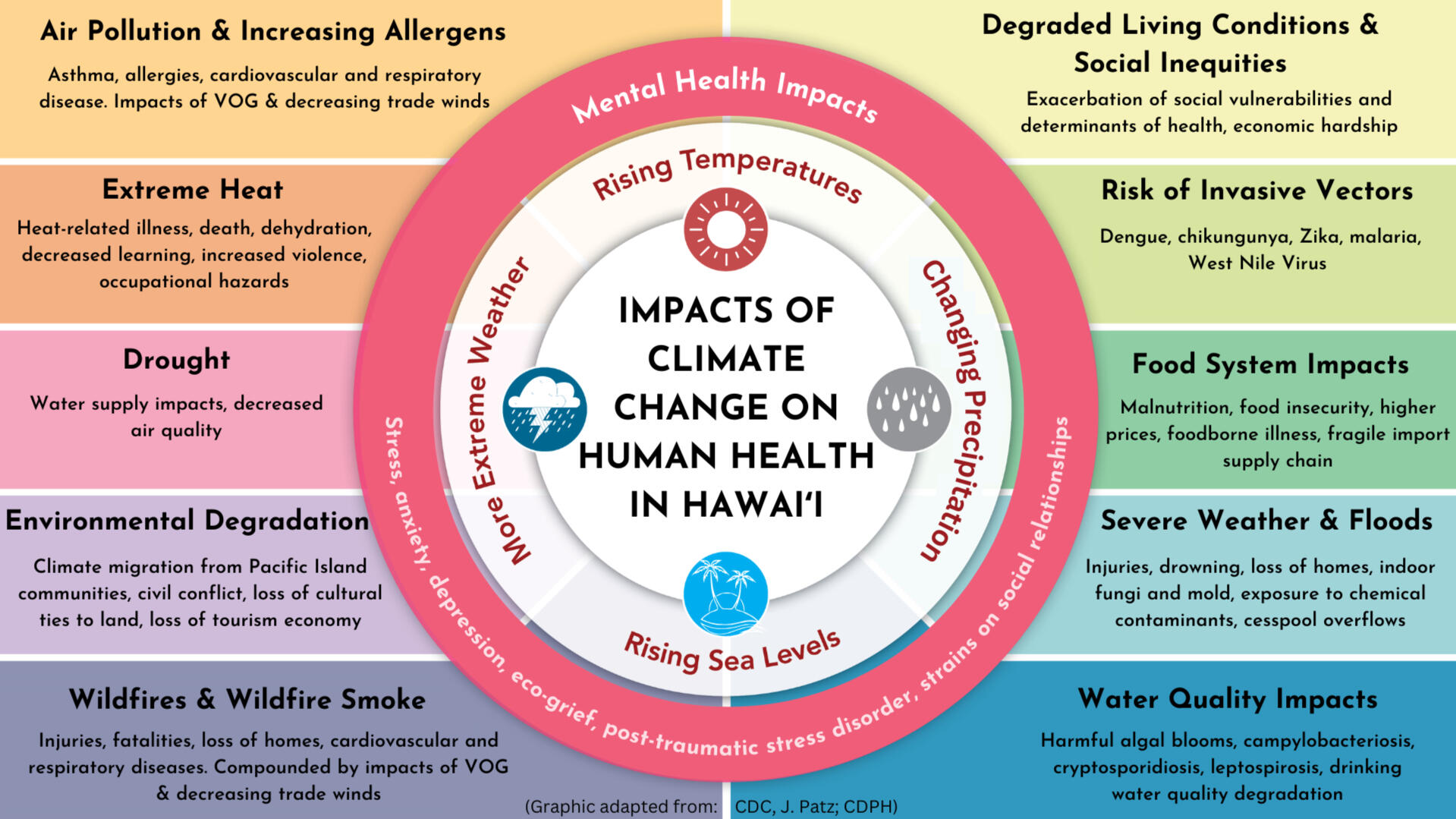
Graphic: Impacts of Climate Change on Human Health in Hawaiʻi (Adapted from California Department of Public Health and the CDC)
| Hawaiʻi Climate Data | |||
|---|---|---|---|
| Extreme Heat | - | 2019 was the hottest year ever recorded on ʻOahu, featuring the hottest day ever recorded in Honolulu's history. | Hawaiʻi's average temperature could increase as much as 5 - 7.5°F by 2100. |
| Drought | - | Average yearly rainfall is declining across all the islands. | |
| Environmental Degradation | - | Hawaiʻi has lost 1.5 million acres of native forests. | |
| Food System Impacts | - | Hawaiʻi imports ~90% of its food. | |
| Rising Sea Level | - | 70% of beaches and 4,000 structures in the state are threatened. | Sea level in Hawaiʻi has already risen 5 inches since 1970. |
| Severe Floods | - | More than 2 trillion gallons of water flooded Hawaiʻi in March 2026. | |
| Water Quality Impacts | - | 53 million gallons of untreated sewage are released into Hawaiʻi's waterways each day. |
Data: Adapted from UNDRR, University of Hawai'i, U.S. Department of Commerce, and Hawaii.gov
Share Your Climate Health Story
Climate & Health Hawaiʻi and Hawaiʻi Green Growth are partnering to document stories from the community on the connection between climate change and health through 45-60 minute virtual interviews.Sign up for one-on-one interviews to discuss personal / community experiences with severe weather events, wildfires, extreme heat, and other impacts of climate change:
Interest and Consent Form:
Action Work Groups
Climate & Health Hawaiʻi consists of several subgroups to help guide discussions:
Community Listening Sessions
Centering lived experience in climate-health planning
2026 Policy Priorities
Advancing climate-health legislation
2026 Priority Bills:
House Bills (HB)
Senate Bills (SB)
Policy priorities are selected using the rubric below:
Mental Health Subgroup
Addressing climate anxiety and trauma
(Coming Soon!)
Education Subgroup
Developing culturally grounded learning resources
(Coming Soon!)
Our Impact
Founded: June 2023Newsletter subscribers #: 284Steering committee members #: 13Events held: 3 Community Listening Sessions, 3 kūpuna-focused eventsMain policy focuses: Heat-related illness, cesspool-related waterborne illness
↪ Wrote & passed SCR111 (2025), declaring climate change a public health emergency in Hawaiʻi
Stay in Touch
Subscribe to be sent the latest information, meetings, and events from Climate & Health Hawaiʻi.
Financial Disclosure: Hawaiʻi Public Health Institute is the fiscal sponsor of Climate & Health Hawai'i